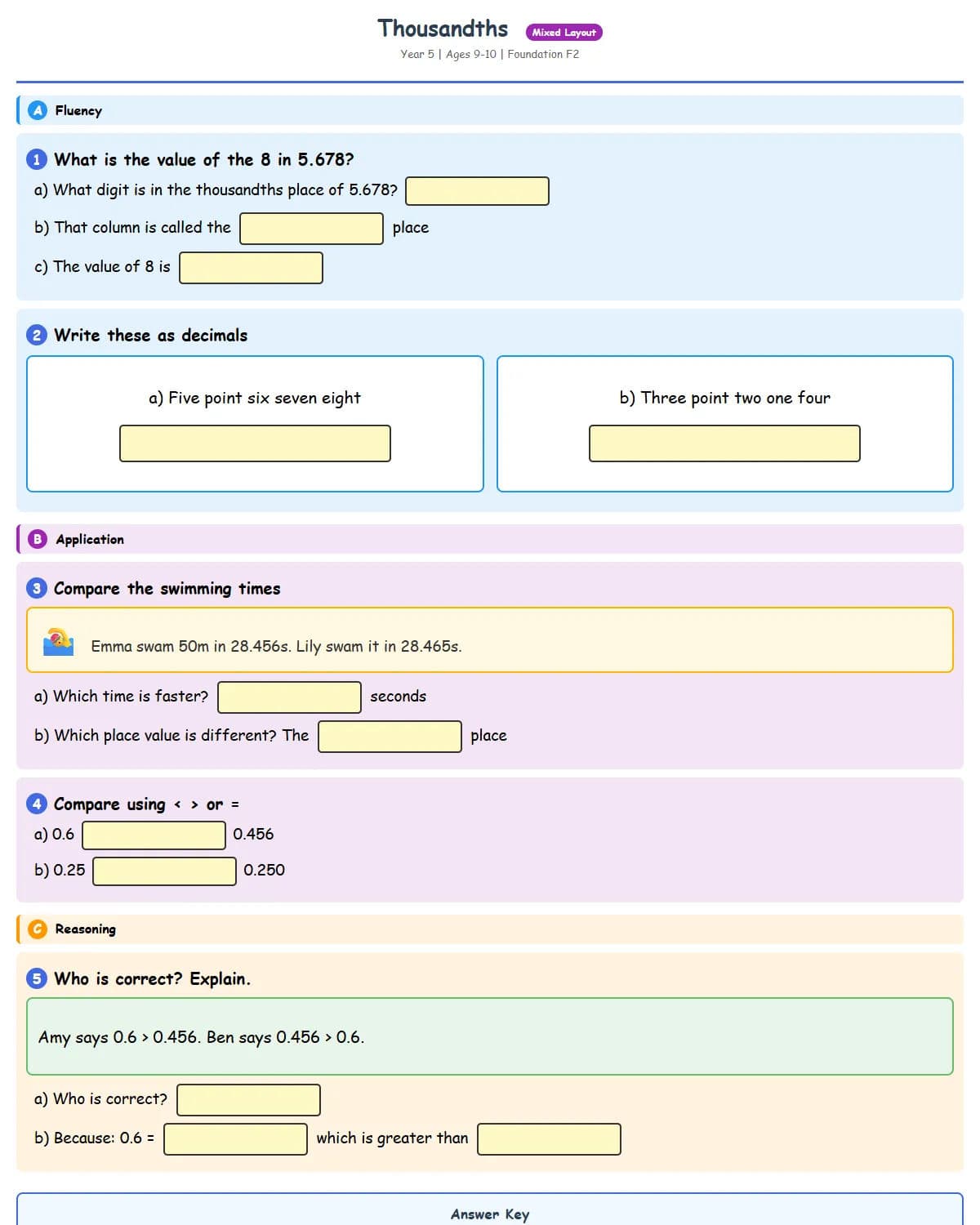
Thousandths (Foundation 2 - Swimming Theme)
About this worksheet
Download free Year 5 (Grade 5) decimals worksheet featuring default. Perfect for classroom or homeschool learning. Print-ready PDF.
About This Worksheet
This Year 5 decimals worksheet focuses on the crucial subtopic of thousandths, providing essential practice for building a strong foundation in number sense. Understanding decimals, particularly thousandths, is a key skill outlined in the UK National Curriculum for Year 5 mathematics. This worksheet allows pupils to practice identifying the place value of digits in decimal numbers, reading and writing decimals to three decimal places, and comparing and ordering decimals involving thousandths. By working through these exercises, pupils develop their understanding of the relationship between tenths, hundredths, and thousandths, enhancing their overall number sense. This practice builds confidence in working with decimals, a skill that is essential for future mathematical learning, including fractions, percentages, and measurement. Furthermore, understanding decimals has real-world applications, such as measuring ingredients in cooking, understanding financial transactions, and interpreting scientific data. This worksheet provides valuable practice in these fundamental skills, making it an invaluable resource for Year 5 teachers looking to support their pupils' learning in decimals and thousandths. Regular practice with worksheets like this helps solidify understanding and promotes fluency, leading to greater success in more complex mathematical tasks. The skills developed through this worksheet are directly applicable to problem-solving and reasoning activities involving decimals.
Learning Objectives
- ✓Identify the place value of digits in numbers with up to three decimal places.
- ✓Read, write, order and compare numbers with up to three decimal places.
- ✓Understand that thousandths are smaller than hundredths and tenths.
💡 How to Use This Worksheet
This worksheet is designed to be used as an introductory activity or for reinforcing understanding of thousandths for Year 5 pupils. It can be used after a whole-class teaching session on decimals and place value. For pupils who are struggling, provide concrete manipulatives such as place value counters or base ten blocks to help them visualise the thousandths. Encourage them to draw place value charts to organise their thinking. Common mistakes to watch out for include confusing the place value of digits after the decimal point and misinterpreting the relative size of tenths, hundredths, and thousandths. For pupils who grasp the concept quickly, extend their learning by asking them to convert fractions to decimals involving thousandths or to solve simple word problems involving measurements in thousandths (e.g., measuring the length of an object to the nearest thousandth of a metre).
Skills Developed
❓ Frequently Asked Questions
What age is this worksheet suitable for?
This worksheet is specifically designed for Year 5 pupils (ages 9-10) who are learning about decimals and thousandths.
What skills does this worksheet help develop?
This worksheet helps develop skills in place value understanding, decimal number recognition, and comparing and ordering numbers with up to three decimal places.
How long does this worksheet take to complete?
This worksheet is estimated to take around 20 minutes to complete, depending on the pupil's prior knowledge and speed.
Can I customize this worksheet?
Yes, you can generate similar worksheets with different themes and difficulty levels using our worksheet generator. This allows you to tailor the learning experience to the specific needs of your pupils.